
VEMLIDY demonstrated a well-established safety profile for a broad range of patient types through 8 years1-4
Trials 108 and 110 (pooled)
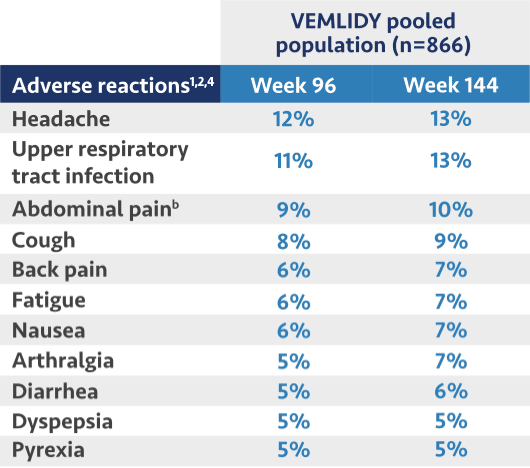
The proportion of patients who discontinued treatment at Week 96 due to ARs of any severity was 1.5% with VEMLIDY and 0.9% with TDF. At Week 144, the discontinuation rates due to ARs of any severity were 1.6% with VEMLIDY and 1.6% with TDF.1,2
Adverse reactionsa (all grades) reported in ≥5% of patients on VEMLIDY in Trials 108 and 110 (Week 96 and Week 144 analyses)
Differences were observed between VEMLIDY and TDF in certain lipid parameters1-3
In Trials 108 and 110:
- Week 96: Mean changes from baseline in low-density lipoprotein cholesterol (LDL-C; fasted) and triglycerides (TG; fasted) were +7 mg/dL and +13 mg/dL for VEMLIDY, versus -10 mg/dL and -7 mg/dL for TDF1
- Week 144: Mean changes from baseline in LDL-C (fasted) and TG (fasted) were +8 mg/dL and +18 mg/dL for VEMLIDY, versus -8 mg/dL and -2 mg/dL for TDF2
- Week 384: Among patients receiving VEMLIDY, the median change in LDL-C (fasted) was +16 mg/dL and TG (fasted) was +9 mg/dL. Among patients who switched from TDF to VEMLIDY at Week 96, the median change in LDL-C (fasted) was +17 mg/dL and TG (fasted) was +11 mg/dL. Among patients who switched from TDF to VEMLIDY at Week 144, the median change in LDL-C (fasted) was +11 mg/dL and TG (fasted) was +14 mg/dL3
In Trial 4018:
- Week 48: Changes from baseline in lipid parameters in the VEMLIDY and TDF groups were similar to those observed in Trials 108 and 110 at Week 961
- Week 96: Lipid parameters in patients who were switched from TDF to VEMLIDY at Week 48 were similar to those of patients who continued on VEMLIDY2
8-year safety data
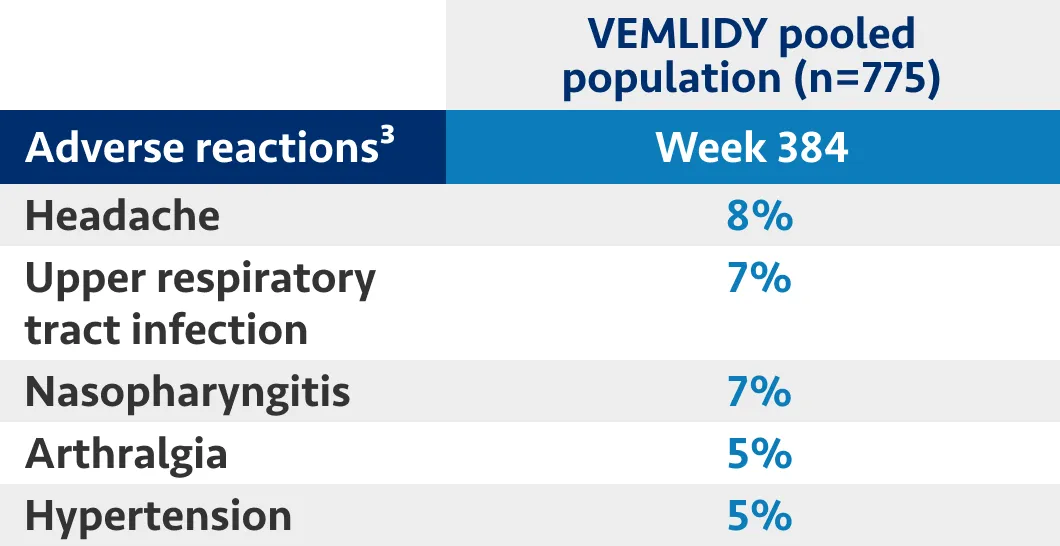
Pooled Safety Analysis (Week 384): Pooled safety analysis (observed data) from Trials 108 and 110 was assessed at Week 384. This analysis includes 866 patients who initiated VEMLIDY at baseline, 207 patients who switched from TDF to VEMLIDY at Week 96, and 225 patients who switched from TDF to VEMLIDY at Week 144.3
Most common ARs (all grades) reported in ≥5% of patients on VEMLIDY who entered the open-label extension (Week 384 analysis)
The 8-year analysis is not presented in the VEMLIDY full Prescribing Information.
HCC surveillance in Trials 108 and 110 through Week 384
At Week 384, there were a total of 21 cases (1.6% incidence) of hepatocellular carcinoma (HCC) observed in Trials 108 and 110.3,a,c
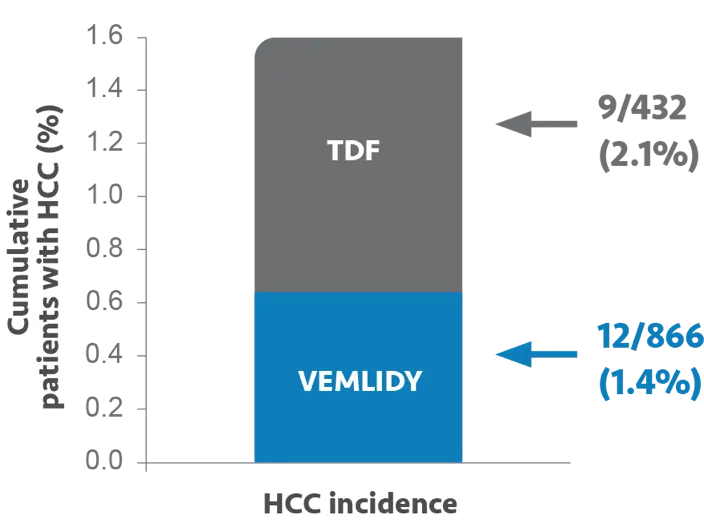
HCC surveillance was included as part of the 96-week protocol amendments for Trials 108/110. These trials were not powered to look at any treatment effect on HCC and no results should be drawn based on these observations. This information is not in the VEMLIDY Prescribing Information.2
AR=adverse reaction; TDF=tenofovir disoproxil fumarate.
a Frequencies of adverse reactions are based on all treatment-emergent adverse events, regardless of relationship to study drug.1
b Grouped term including abdominal pain upper, abdominal pain, abdominal pain lower, and abdominal tenderness.1
c 3 cases of HCC were observed in the open-label TDF➔VEMLIDY group, all of which developed before Week 48 of the open-label phase.2
Use of VEMLIDY in special populations1

Pregnancy
- There is a pregnancy exposure registry that monitors pregnancy outcomes in women exposed to VEMLIDY during pregnancy. Healthcare providers are encouraged to register patients by calling the Antiretroviral Pregnancy Registry (APR) at 1-800-258-4263
- Available data from the APR show no statistically significant difference in the overall risk of birth defects for tenofovir alafenamide (TAF) compared with the background rate for major birth defects of 2.7% in the US reference population of the Metropolitan Atlanta Congenital Defects Program (MACDP). The rate of miscarriage is not reported in the APR. The estimated background rate of miscarriage in clinically recognized pregnancies in the US general population is 15% to 20%
- Based on prospective reports to the APR of over 1330 exposures to TAF-containing regimens during pregnancy resulting in live births (including over 1080 exposed in the first trimester and over 240 exposed in the second/third trimester), the prevalence of birth defects in live births was 3.9% (95% CI: 2.8% to 5.2%) and 4.8% (95% CI: 2.5% to 8.3%) following first and second/third trimester exposure, respectively, to TAF-containing regimens. Methodological limitations of the APR include the use of MACDP as the external comparator group. The MACDP population is not disease-specific, evaluates women and infants from a limited geographic area, and does not include outcomes for births that occurred at less than 20 weeks’ gestation

Lactation
- Data from the published literature report the presence of TAF and tenofovir in human milk. Data from the published literature have not reported adverse effects of TAF on a breastfed child. There are no data on the effects of TAF on milk production
- The developmental and health benefits of breastfeeding should be considered along with the mother’s clinical need for VEMLIDY and any potential adverse effects on the breastfed infant from VEMLIDY or from the underlying maternal condition

Geriatric use
- VEMLIDY has been administered to 89 patients aged 65 and over in clinical trials, and no differences in safety or efficacy have been observed between these patients and younger patients

Patients with ESRD
- No dosage adjustment is needed for patients with ESRD (eCrCl <15 mL/min) receiving chronic hemodialysis
- In patients on chronic hemodialysis, on hemodialysis days, administer VEMLIDY after completion of hemodialysis treatment
- VEMLIDY is not recommended in patients with ESRD who are not receiving chronic hemodialysis
CI=confidence interval; eCrCl=estimated creatinine clearance; ESRD=end-stage renal disease.
References: 1. VEMLIDY Prescribing Information. Foster City, CA: Gilead Sciences, Inc.; March 2024. 2. Data on file. Gilead Sciences, Inc. 3. Buti M, Lim YS, Chan HLY, et al. Eight-year efficacy and safety of tenofovir alafenamide for treatment of chronic hepatitis B virus infection: final results from two randomised phase 3 trials. Aliment Pharmacol Ther. 2024;60(11-12):1573-1586. doi:10.1111/apt.18278 4. Agarwal K, Brunetto M, Seto WK, et al; GS-US-320-0110 and GS-US-320-0108 investigators. 96 weeks treatment of tenofovir alafenamide vs. tenofovir disoproxil fumarate for hepatitis B virus infection. J Hepatol. 2018;68(4):672-681. doi:10.1016/j.jhep.2017.11.039 5. TDF (tenofovir disoproxil fumarate) Prescribing Information. Gilead Sciences, Inc.; April 2019. 6. BARACLUDE (entecavir) Prescribing Information. Bristol-Myers Squibb; November 2019.